
Is Norway Safe and Accessible for Solo, Family, and Older Travelers?
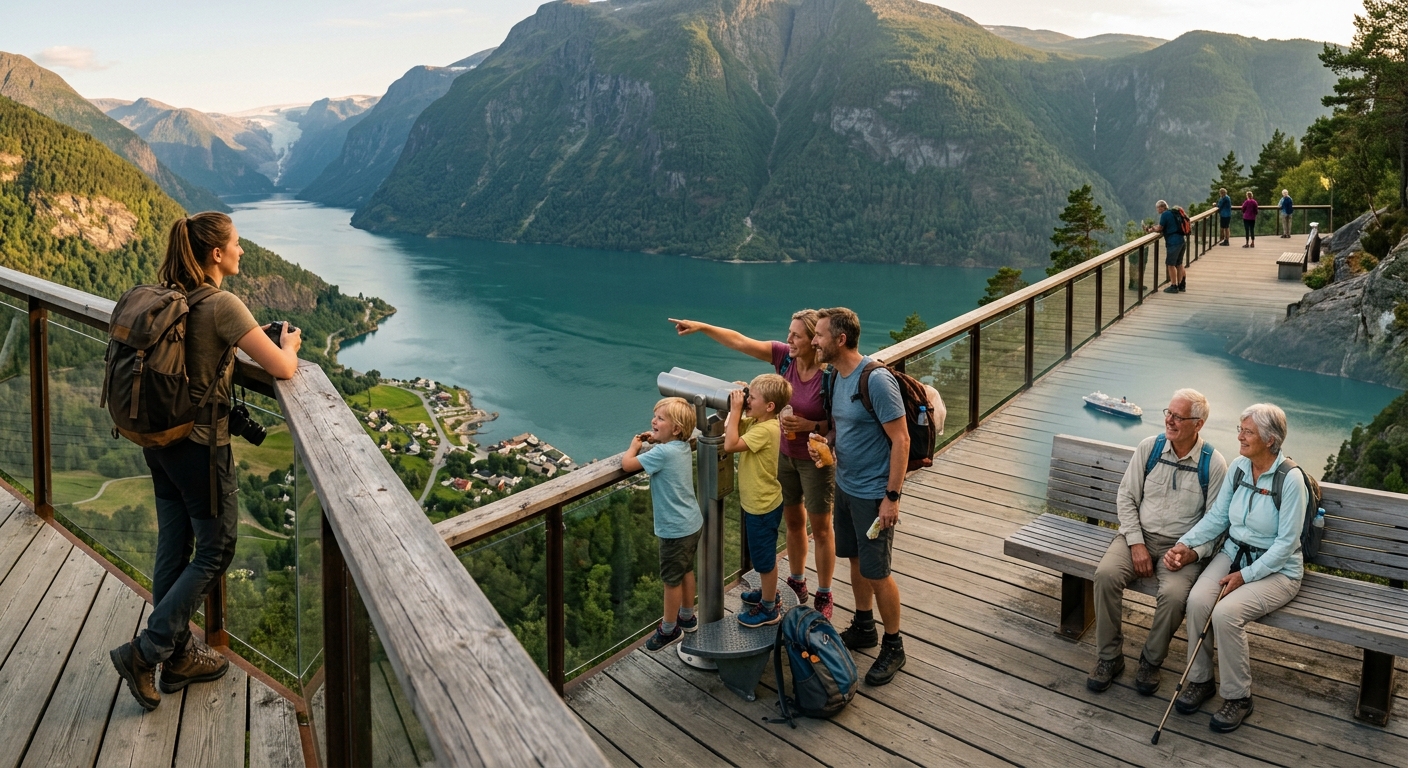
- Norway consistently ranks among the safest countries for personal safety and low crime — solo travelers, including women traveling alone, generally report feeling secure in cities and rural areas alike.
- Family-friendliness is a genuine strength: Norwegian culture is built around outdoor family life, and infrastructure reflects that.
- Accessibility for mobility-limited or older travelers is strong in cities and on major transport but drops significantly on unguided trails and in remote wilderness areas.
- The real risk profile in Norway isn't crime — it's weather and terrain. Respecting both matters more here than personal security precautions.
- Each group's actual constraint is different: solo travelers manage logistics alone, families manage pacing and engagement, older or mobility-limited travelers manage terrain and stamina.
Solo travelers
Norway is one of the more straightforward countries to travel solo, and this holds for women traveling alone specifically — the country consistently scores near the top of global safety and gender-equality indices, and solo travelers commonly report feeling comfortable walking city streets at night or navigating public transport alone. English is spoken widely and fluently, even in smaller towns.
The actual challenge for solo travelers in Norway isn't personal safety — it's logistics and cost. Many activities are priced per group rather than per person, which can make solo travel proportionally more expensive. Group activity tours (glacier hikes, rafting, guided walks) solve this efficiently, since you're joining a scheduled departure rather than needing a group of your own.
Solo hiking in remote wilderness is the one area worth genuine caution — not because of other people, but because rescue response times in remote fjord and mountain areas can be long, and cell coverage isn't universal. Sticking to marked trails and telling someone your route and expected return time is standard practice here.
Families
Norwegian culture treats outdoor family life as a norm rather than a niche interest — the concept of "friluftsliv" (open-air living) is woven into how Norwegians raise children, and the country's public infrastructure reflects it. Trains and ferries are genuinely comfortable for families with young children, museums are designed with hands-on, kid-engaging exhibits, and many hiking trails have clearly graded difficulty.
The real planning question for families isn't whether Norway works — it clearly does — but pacing. The activities that make adventure-focused itineraries appealing (full-day glacier hikes, long via ferrata routes) are often not appropriate for young children, while gentler alternatives (fjord cruises, reindeer sledding, wildlife safaris, most museums) work well across a wide age range.
Most guided activities set minimum ages for good safety reasons (typically 10–12 for glacier hiking and via ferrata) — checking this before booking avoids disappointment on arrival.
Older travelers and mobility-limited travelers
This is where the honest answer genuinely splits by activity type. Norway's cities, major museums, and scheduled transport (trains, ferries, most cruises) are well-built for older travelers and largely wheelchair-accessible. A trip built around cities, cruises, and museums works well for travelers with limited mobility or reduced stamina.
Unguided wilderness trails, most guided adventure activities, and some remote accommodation are a different story — accessibility there drops significantly. A cabin reachable only by a steep unpaved path, or a viewpoint requiring hours of uneven walking, simply isn't accessible regardless of how it's marketed.
The practical approach is to ask specifically, activity by activity, rather than assuming a blanket answer for "Norway" — a fjord cruise and a glacier hike are both technically "adventure travel," but one is broadly accessible and the other genuinely isn't for many travelers with mobility limitations.
- Solo travelers: budget for the per-group cost of some activities and accommodation, and favor scheduled group tours over private bookings for value
- Families: check specific minimum ages before booking any guided adventure activity
- Older or mobility-limited travelers: ask specifically about terrain and accessibility for each activity, not just the destination as a whole
- Weather and terrain respect — this is the real risk factor in Norway, regardless of who's traveling
- Telling someone your plan for any unguided outdoor activity, solo or otherwise
- Choosing accommodation and transport as your base if mobility or pacing is a genuine constraint